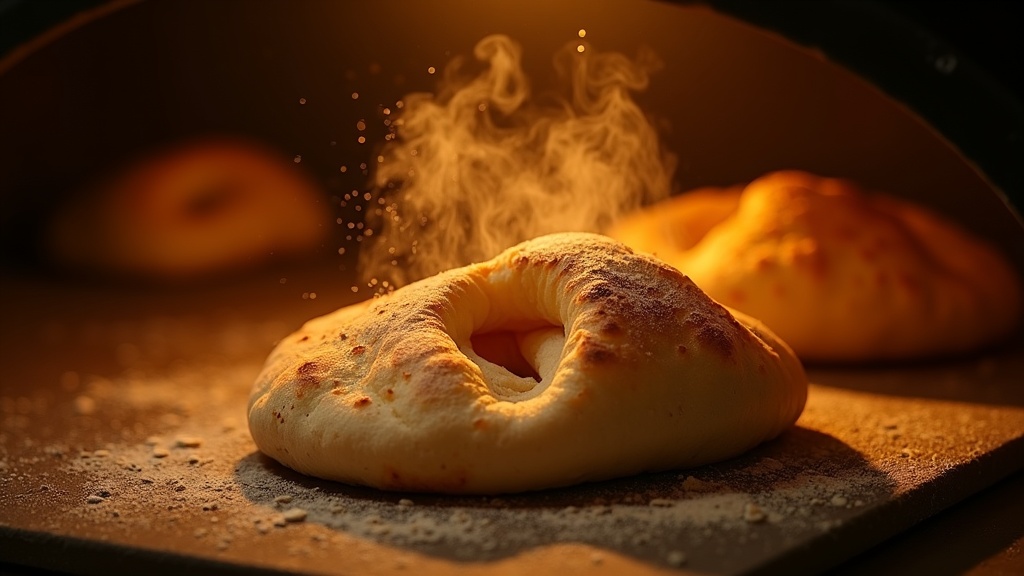
The 3-Second Pocket: The Physics of Pita Ballooning and Why Your Oven is a Pressure Chamber

Listen. This morning we talked about the Maillard reaction—surface chemistry, browning, the alchemy of the crust. Now we're going deeper. Into the pocket. Into the physics of what happens when a paper-thin round of Lebanese khubz hits 475°F and decides, in a window of roughly three seconds, whether it's going to balloon into a hollow sphere or emerge as a sad, flat cracker.
This isn't baking. This is thermodynamics wearing an apron.
The Architecture of a Pocket
To understand the pita pocket, you have to stop thinking about bread as food and start thinking about it as a pressure vessel. The Lebanese khubz (what most Americans call "pita") is engineered for a specific mechanical outcome: the separation of two gluten membranes under steam pressure.
Here's the structure. You've got a dough that's been rolled to roughly 3-4mm thickness. That's not arbitrary. Too thick, and the outer layers set before the internal steam builds enough pressure to separate them. Too thin, and you don't have the structural integrity to contain the pressure burst. (The Egyptians understand this distinction intimately—their eish baladi is intentionally thicker, heartier, designed for tearing and dipping rather than pocket-stuffing. Same family, different engineering specs.)
The gluten network is your pressure vessel wall. When that dough hits the oven—whether it's a commercial deck oven, a screaming-hot home steel, or the traditional saj—three things happen simultaneously:
- The Yeast Sprint: Residual yeast activity goes into overdrive in the first 30 seconds, generating CO₂ at an accelerated rate.
- The Steam Explosion: Water trapped in the dough—roughly 60-65% hydration in a standard khubz formula—flash-converts to steam. Here's the number that matters: water expands by a factor of approximately 1,600 when it vaporizes at atmospheric pressure. That expansion happens inside a closed system. The pressure builds fast.
- The Gelatinization Race: Starch granules begin absorbing water and swelling at around 50°C (122°F), continuing up to 80°C (176°F). This creates a semi-rigid structure—but if it happens too fast on the outside, you seal the vessel before the pressure peaks. Game over. Flatbread.
(This is why humidity in the first 90 seconds is non-negotiable. Steam in the oven environment delays surface gelatinization, buying you time for internal pressure to build. Professional bakeries inject steam; home bakers use ice cubes, spray bottles, or covered baking vessels. Same physics, different tools.)
Here is the Move: The Thermal Window
The pocket doesn't form gradually. It happens in a burst. You've got a window of roughly 3-5 seconds where the internal steam pressure exceeds the tensile strength of the gluten membrane—but not by so much that it ruptures the structure entirely.
At the Lebanese bakery where I worked in Brooklyn, the master baker could call it from across the room. "That one's dead," he'd say, watching a round hit the oven floor. I'd stare, seeing nothing but pale dough. Twenty seconds later, sure enough—no balloon. No pocket. Just a flat disc.
What was he seeing? Thermal transfer rates. The way the dough hit the stone. Whether it landed with a slight fold that would create an uneven heat distribution. Whether the surface moisture was sufficient to delay gelatinization on the bottom while the top received radiant heat.
The physics are brutal and beautiful. You need:
- Oven temperature: 450-500°F (232-260°C). Lower, and the steam builds slowly—giving the starch time to set the walls before separation occurs. Higher, and you risk scorching the exterior before the interior pressure peaks.
- Surface moisture: The dough needs to enter the oven with enough surface hydration to create a micro-layer of steam between the bread and the hot surface. This is the "steam cushion" that allows the initial expansion.
- Uniform thickness: A variance of even 1mm can create a weak point where the steam escapes rather than building pressure.
The Lebanese vs. Egyptian Divergence
Not all pocket breads are engineered the same. The Lebanese khubz is thin, pliable, designed specifically for that pocket formation. It's white flour, moderate protein (11-12%), rolled almost translucent. The Egyptian eish baladi takes a different approach entirely—whole wheat, 10-14% protein, thicker, denser. It can pocket, but that's not its primary function. It's a utensil, a vehicle for ful medames and taameya, meant to tear and dip rather than stuff and fold.
(The word baladi itself is telling—it translates roughly to "of the land" or "traditional," signaling a heritage preparation that predates the refined white-flour versions of the Levant. Context is an ingredient. Always.)
If you're attempting this at home, know which tradition you're working in. The Lebanese method demands precision—the thin roll, the hot stone, the steam injection. The Egyptian method is more forgiving, more rustic, more about the nutty depth of whole wheat than the architectural drama of the balloon.
The Failure Modes (And What They Teach Us)
I've made thousands of pitas. I've failed at hundreds. Each failure is data:
The Flat: No pocket, dense crumb. Usually means your oven wasn't hot enough, or your surface gelatinized too fast. The starch set before the steam could separate the walls.
The Blowout: A hole in the side, steam escaping, partial puff. Weak point in the gluten—either uneven rolling, or the dough was too dry and cracked under pressure.
The Double-Pocket: Two small chambers instead of one clean hollow. Uneven heat distribution—your stone or steel has hot spots, or you didn't rotate the dough properly.
Here's what separates a good pita from a transcendent one: the socarrat principle applies even here. The slight char, the spots where the dough nearly blistered through—that's where the flavor concentrates. The Lebanese bakers I worked with aimed for a 15-20% char coverage. "That's the taste of the oven," one told me. "The fire talking back."
Home Kitchen Translation
You don't need a clay tannur or a commercial deck oven. You need thermal mass and humidity control.
Here is the move: Preheat your heaviest baking steel or stone for a full hour at 500°F. Roll your dough as thin as you can manage—3mm max. Have a spray bottle of water ready. When you load the dough, hit the oven walls with 8-10 sprays of water, then close the door fast. That steam cloud is your insurance policy against premature gelatinization.
Watch through the window. The balloon happens fast—usually between 45 and 90 seconds. When you see that dome rise, you've succeeded. The pressure won. The gluten held. The physics aligned.
Pull it at 2-3 minutes total. The exterior should have spots of deep brown char. The interior should be hollow, the walls tissue-thin.
Sourcing
Flour: For Lebanese-style khubz, use a moderate-protein all-purpose (11-12%) or a blend of AP and bread flour. King Arthur All-Purpose (11.7% protein) is ideal. For Egyptian baladi, seek out high-extraction whole wheat—Anson Mills or Community Grains make excellent options.
Baking Steel: If you don't own one, get one. A 3/8" steel plate from a local metal shop works as well as any branded option. Season it like cast iron.
Specialty Equipment: A heavy marble rolling pin helps achieve the ultra-thin, even roll essential for pocket formation. Wooden pins drag; marble glides.
Further Reading: For the chemistry of starch gelatinization, consult Bakerpedia's technical documentation. For the cultural history of Levantine bread traditions, Anissa Helou's Savory Baking from the Mediterranean is rigorous and respectful.
Tomorrow morning, your pita will deflate. That's fine. Warm it in a dry pan for 30 seconds and it will remember its shape. Bread has memory. Bread has physics. Bread, properly made, is a pressurized steam vessel that happens to be edible.
Don't call it a "pocket." Call it a pressure chamber. You've earned the precision.