The Original Food Tech Was Never in a Lab
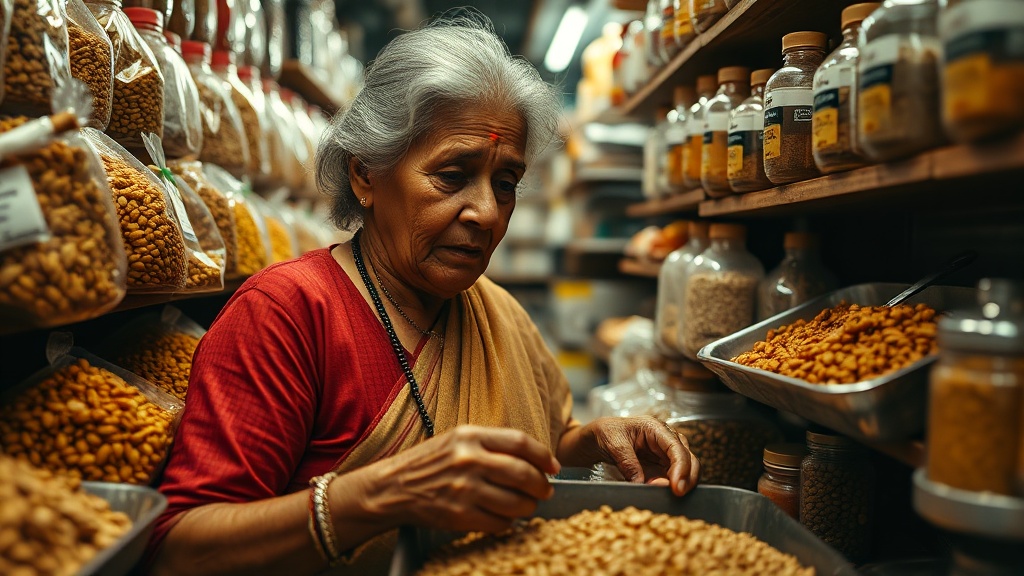
I want to tell you about a woman I'll call Devika.
I met her at Patel Brothers in Jackson Heights on a Tuesday afternoon in 2019, standing in front of a wall of dried lentils, debating aloud with herself about substituting masoor dal for toor in a sambar. She was talking through the texture problem — toor holds its shape, masoor disintegrates faster, she'd need to adjust the tempering sequence — and I asked if she minded if I listened. She looked at me like I'd asked permission to breathe air.
We talked for forty minutes. She had cooked three cuisines across two continents. She knew which hing brand had the most sulfur intensity and therefore required less. She knew that dried tamarind blocks from one regional supplier were denser than another, and adjusted her sour accordingly — by eye, by smell, by thirty years of recalibrated intuition. She ran what was, in practice, an extremely sophisticated substitution algorithm in her head, continuously, without a subscription fee.
Somewhere right now, a food tech startup has raised a seed round to build an app that does what Devika does.
---
Every few months, I see a new announcement. An AI-powered ingredient substitution tool. A fermentation monitoring app. A smart preservation guide for reducing food waste. And I'll read through the features — often thoughtful, often well-designed — and feel this low-grade exhaustion, because I keep watching the industry treat *codified* as synonymous with *invented*.
Fermentation isn't a trend. It's not Noma, and it's not 2012 Brooklyn. Fermented foods are older than writing. The women who built Korean kimchi culture, who perfected [Japanese miso](https://globalflavors.blog/the-miso-hierarchy-why-your-regional-variant-matters-and-when-it-doesnt), who developed the specific salt ratios and temperature management of Ethiopian injera — they were doing microbial engineering centuries before we had that phrase. They passed the knowledge between bodies, not between documents. That's why it got missed.
Ingredient substitution isn't a machine learning problem. It's a generational skill that immigrant cooks developed because the supply chain was never designed for them. You couldn't get tamarind in a lot of American cities for most of the twentieth century, so you developed workarounds. You knew how to [approximate galangal with a combination of ginger and white pepper](https://globalflavors.blog/why-your-h-mart-haul-costs-half-what-it-shouldand-what-youre-doing-wrong-at-checkout). You knew that amchur powder could do some of what sumac does in a pinch, and exactly how much. This knowledge was sophisticated and adaptive and it lived in people, not platforms.
Preservation without refrigeration isn't a "sustainability innovation." It's what you do when you don't have reliable cold storage, or when you're preserving a harvest that represents months of work. The techniques for pickling vegetables across Persian, Korean, Indian, and West African cuisines aren't parallel discoveries. They're evidence of the same human problem solved, over and over, with precise regional variation, mostly by women who needed food to last through seasons.
---
What bothers me about how we tell this history:
We celebrate the Silicon Valley woman who builds a fermentation monitoring device — and I do celebrate her, genuinely, that device is useful — without acknowledging that [the monitoring happened for centuries via touch, smell, the specific resistance of a crock lid, the sound a batch makes on day three versus day five](https://globalflavors.blog/the-135-enzyme-alchemist-what-koji-mold-is-actually-doing-to-your-food-and-why-it-took-humans-3000-years-to-figure-it-out). The knowledge she's encoding was never lost. It was just always in a language that investors couldn't fund.
This isn't an argument against technology. It's an argument about attribution.
When a food tech company "discovers" that many immigrant home kitchens are actually expert practitioners of the exact problems they're trying to solve, I want them to do something with that discovery beyond using it as market validation. I want them to ask: who should be building this? Who should be advising on this? Who has the depth of knowledge that would prevent you from building something that, respectfully, misses the entire point?
---
I spent about three years in the fieldwork phase of my research career watching food anthropologists encounter this problem and not know what to do with it. You find a technique that's been practiced in rural Karnataka across generations, and some version of it shows up in a startup pitch deck in 2022, and the pitch deck calls it "novel." The pitch deck is not lying exactly. It's novel *to them*.
The gap is in who counts as a knowledge holder.
The test kitchen model — professional chefs, food scientists, people with culinary degrees and restaurant credentials — created a specific kind of expertise that the industry knows how to value. The other kind of expertise, the accumulated daily practice of women who cooked to feed families across generations in kitchens that didn't have twelve burners and prep teams, mostly didn't make it into R&D departments. It made it into people. Mostly women.
---
I'm writing this three days before International Women's Day, and I want to say something that doesn't fit neatly on a graphic:
The celebration of [women in food tech](https://globalflavors.blog/women-in-food-tech-are-finally-fixing-what-silicon-valley-ignored) means nothing without the question of whose knowledge that tech is built on.
Women founders building for accessibility, for immigrant cooks, for small kitchens — I mean every word of praise for what they're doing. But the women who deserve recognition this week also include every Devika at every Patel Brothers, every halmeoni who makes kimchi the way her mother taught her, every woman who developed a workaround technique because the supply chain ignored her and the recipe blogs never covered her cuisine. They were doing food tech. They just weren't calling it that, and nobody was paying them to.
The real disruption — if we want to use that word — isn't building a better fermentation app. It's changing who the app goes to learn from before it gets built.
That's the thing Silicon Valley keeps being so close to understanding and then walking back from at the funding stage.
---
There's a sentence I've been carrying around since grad school, from an interview I did with a woman in a Tamil diaspora cooking collective in Toronto. She was explaining why she'd started teaching younger women in her community how to make their grandmothers' dishes rather than "adapting" them for ease.
She said: *"If we simplify it before they know it, they'll never know what they lost."*
I think about that every time I see a food tech product that's designed to make immigrant cuisine more accessible to people who didn't grow up with it, without routing anything back to the people who made it.
Some knowledge doesn't need to be disrupted. It needs to be listened to.
That's the innovation. That's what's actually being built in [the best food tech coming out of women founders](https://globalflavors.blog/women-chefs-in-culinary-arts-international-womens-day-2026) right now. Not novelty — listening. Not disruption — translation. Not invention — attribution.
It's harder than building an app. It takes longer. It doesn't pitch well.
It's also the only thing that works.
---
*Sloane Katz is a former ethnographic researcher and current denizen of H-Mart and Patel Brothers. She lives in Queens and is deeply skeptical of anything described as "clean" and "effortless."*